





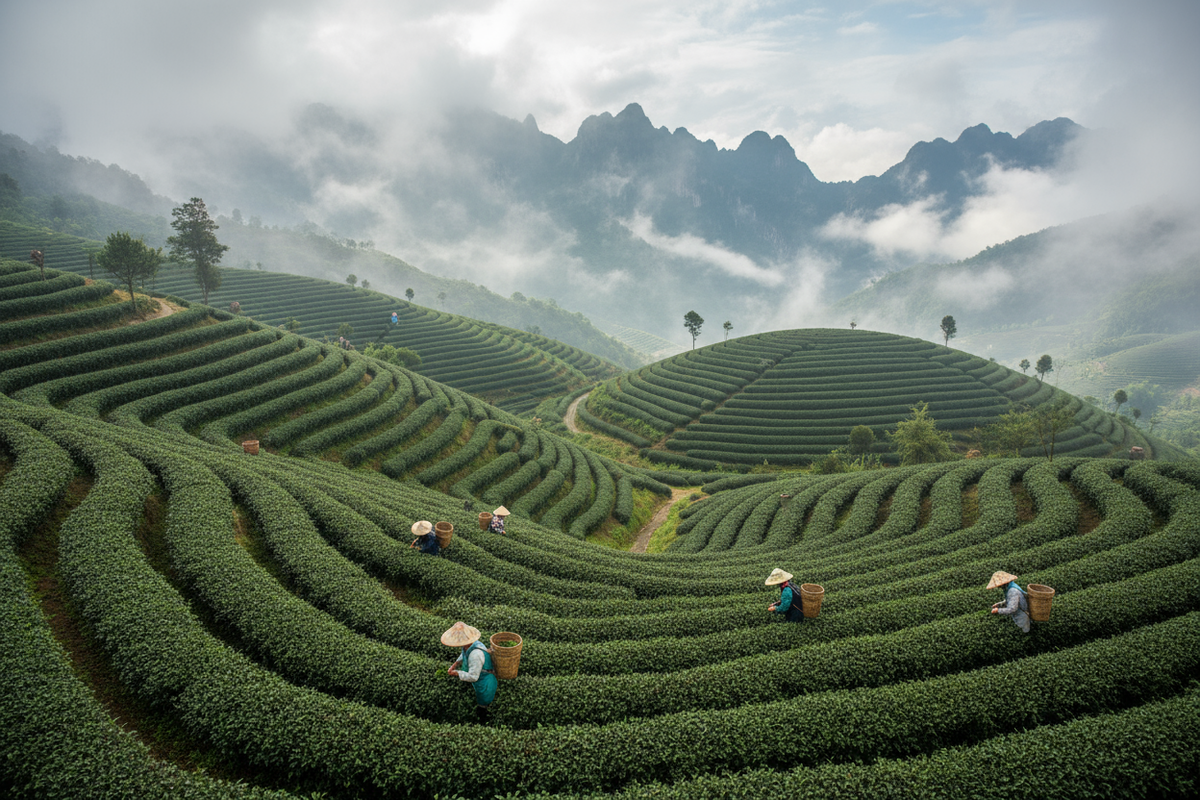
Taiwan's Highland Oolong: Where the finest Gaoshan teas grow
Taiwan is renowned for its exquisite oolong tea, which delights tea lovers worldwide. The country's high-altitude mountain regions, such as Alishan, Shanlinxi, Lishan, and Dayuling, are particularly famous for their exceptional tea quality. But what makes these regions so special? Join us on a journey to Taiwan's four most celebrated highland tea regions and discover their unique characteristics.

1. Alishan Oolong - Where the clouds embrace the tea
The region around the Alishan mountain range (Chiayi County) is considered one of the most famous sources of highland oolong tea. The term "highland" (Taiwanese: 高山茶, gāoshān chá) here refers to tea gardens at altitudes above approximately 1000 m.
Growing region & conditions
In the Alishan region, the tea gardens typically extend at altitudes between about 1,000 and 1,400 meters.
Characteristic features include strong fog and cloud formation, relatively cool temperatures, a pronounced temperature difference between day and night, and comparatively low solar radiation – all factors that cause slower growth of the tea leaves and thus promote their quality.
The soil: According to sources, it consists of weathered laterite or volcanic soils with good drainage and slight acidity (pH approximately 4.5-5.2) – a favorable terroir for aromatic tea leaves.
Cultivare
The dominant cultivar is Qingxin Oolong (青心烏龍, “Green Heart”) – this is slow growing, comparatively low yielding, but particularly impresses with its fine aromas and flavor notes.
In addition, the cultivar Jin Xuan (金萱, also called “Milk Oolong”) or small proportions of other varieties are occasionally found, but the Qingxin cultivar has proven best for the true high-altitude Alishan teas.
The combination of altitude, fog, cool nights, and slow leaf development leads to the tea leaves producing more amino acids (e.g., theanine) and aromatic oils. This results in mild, floral, almost "creamy" notes – typical of Alishan Oolong.
Typical taste profile
Alishan Oolong is a very fine, elegant oolong with floral notes (e.g. lily, orchid), a gentle sweetness, little bitterness and a clean, clear finish.

2. Shanlinxi Oolong - Taiwan's green paradise
The Shanlinxi region (杉林溪) is located in Nantou County and is a somewhat less well-known growing region, but is a highly respected highland tea region in terms of quality.
Growing region & conditions
The tea gardens in Shanlinxi are often located at altitudes between approximately 1,200 and 1,900 meters.
The Longfengxia area (龍鳳峽) within the Shanlinxi region is particularly well-known, with altitudes around 1,800 m.
Fog and cloud formation, abundant moisture, and a pronounced day-night temperature difference ensure slow leaf growth and high leaf quality.
Cultivare
Even at this altitude, the Qingxin tea cultivar is dominant.
Due to the climate, other “vellier” varieties like Jin Xuan are less relevant – this is about more subtle high-altitude aromas.
The higher altitude of the tea gardens ensures that the tea leaves develop thicker cell walls and more pectin, while simultaneously producing fewer bitter substances. This results in a clear, floral flavor with depth – ideal for discerning oolong drinkers.
Typical taste profile
Shanlinxi Oolong often has a lively yet elegant character: floral and fresh, with a clear sweetness, little bitterness, and a delicate aftertaste. Some describe its fragrance as reminiscent of jasmine or garden flowers.

3. Lishan Oolong - Where tea touches the stars
The Lishan region (梨山, Taichung or Nantou County) is one of the highest tea-growing areas in Taiwan and therefore enjoys the reputation of being one of the top locations for Oolong tea.
Growing region & conditions
Lishan tea gardens are typically located at altitudes of approximately 1,600 to over 2,500 meters.
Some sources mention altitudes between 1,800-2,200 m or even up to 2,300 m and more.
The region benefits from a particularly cool climate, strong fog formation, good water conditions and relatively short growing periods – all of which promotes high aroma and leaf structure quality.
Cultivare
Here too, Qingxin is the main cultivar in highland cultivation.
Due to the extreme altitude, tea leaves develop with a dense cell structure, which meets the requirements for high-class highland oolong tea.
The greater height results in even longer leaf development, a higher proportion of amino acids and aromatic compounds, and less bitterness. This makes Lishan oolongs among the highest quality teas in Taiwan.
Typical taste profile
Elegant floral notes combined with a delicate fruity sweetness (pear and white peach), soft on the palate, little bitterness, good length in the aftertaste.

4. Dayuling Oolong - The jewel of the highland tea regions
The region around Dayuling (大禹嶺) is considered the most exclusive highland area for Oolong cultivation in Taiwan – and is often referred to as the “King of Highland Oolongs”.
Growing region & conditions
Dayuling is one of the highest commercial tea-growing regions in Taiwan, with altitudes between approximately 2,200 and 2,600 meters or even higher.
At this altitude, growing conditions are particularly demanding: very low average temperatures, strong night-to-day temperature differences, shortened growing season, lower yields – all this leads to exceptional leaf density and aroma concentration.
Due to environmental protection and erosion, many tea gardens above 2400 meters have been temporarily shut down, further limiting the availability of this type of tea.
Cultivare
Here too, Qingxin is mainly cultivated, as this cultivar has proven to be the most suitable for these extreme altitudes.
Because the growing conditions are so challenging, there are very few tea farmers in this region, which makes this tea a real rarity.
The higher the altitude, the slower the growth, the higher the concentration of ingredients such as amino acids and flavor compounds – at the same time, bitterness decreases and the leaf acquires a special clarity and depth of flavor. Dayuling is practically the pinnacle of what Taiwan has to offer in highland cultivation.
Typical taste profile
A very pure, delicate oolong with a clear, almost "cool" mountain aroma, sometimes with notes of osmanthus, lily, or delicate fruits, yet with a noticeable depth, a full-bodied mouthfeel, and an elegant finish. Due to its limited production, it is considered a collector's item.

5. Comparison & Summary
| region | Height | Main cultivar | Special features |
|---|---|---|---|
| Alishan | approx. 1,000–1,400 m | Qingxin (often) | Fog, cool climate, mild alpine sweetness |
| Shanlinxi | approx. 1,200–1,900 m | Qingxin | Wooded location, precision, floral style |
| Lishan | approx. 1,600–2,500 m | Qingxin | Very high altitude, winter harvest, elegant depth |
| Dayuling | approx. 2,200–2,600 m or more | Qingxin | Extreme location, low volume, highest quality |
Typically, the Qingxin cultivar is used for genuine highland oolong tea in Taiwan.
The higher the altitude and the cooler the climate, the slower the tea leaves grow – an important prerequisite for higher quality: thicker leaves, more pectin-like substances, more complex aromas.
Each region offers different terroir nuances: fog frequency, soil composition, hours of sunshine, day-night variations – all of this affects aroma, mouthfeel and aftertaste.
The price and rarity often increase with the altitude or exclusivity of the region – e.g., Dayuling is among the most expensive Oolong in Taiwan.

Conclusion
If you are interested in highland oolong from Taiwan, you should choose based on the following criteria:
Region & Altitude : Higher altitudes generally offer more refined flavors, but also higher prices.
Cultivar : Qingxin is the classic highland cultivar and offers the typical “high-mountain” characteristics.
Harvesting & Processing : Spring or winter picking and gentle processing (slight oxidation) promote quality.
Terroir nuances : Pay attention to whether the leaf comes from foggy regions, how high the temperature differences are, and what the soil conditions are – this strongly influences taste and style.

The four teas mentioned – Alishan, Shanlinxi, Lishan and Dayuling – offer a wonderful range of what Taiwan has to offer in the field of High-Mountain Oolong: from elegantly approachable (Alishan) to luxurious and collectible (Dayuling).
Of course, you can find all four tea varieties here in the Evergreen Teashop:
1. Xiding Alishan Oolong Tea from Taiwan
2. Shanlinxi High Mountain Oolong Tea from Long Feng Xia Canyon
3. Lishan High Mountain Oolong Tea from Taiwan, lightly fermented
0 comments